
The following is one of my favorite moments from his engrossing documentary My Voyage to Italy (1999). In this sequence he discusses the films of Antonioni. In particular, I enjoy his ruminations on L'Eclisse. Scorsese's narration is so elucidating and personal ... his voice is calming and provides the perfect sound for a meditation on the art of film and its effect on the person who has the luck of experiencing a great work. Scorsese's passion for film is contagious and communicated, not in a delirious crushing professorial manner, but through intonations of soothing love.
Nov 17, 2009
Scorsese Meditation
Today is the 67th birthday of director Martin Scorsese.
The following is one of my favorite moments from his engrossing documentary My Voyage to Italy (1999). In this sequence he discusses the films of Antonioni. In particular, I enjoy his ruminations on L'Eclisse. Scorsese's narration is so elucidating and personal ... his voice is calming and provides the perfect sound for a meditation on the art of film and its effect on the person who has the luck of experiencing a great work. Scorsese's passion for film is contagious and communicated, not in a delirious crushing professorial manner, but through intonations of soothing love.
The following is one of my favorite moments from his engrossing documentary My Voyage to Italy (1999). In this sequence he discusses the films of Antonioni. In particular, I enjoy his ruminations on L'Eclisse. Scorsese's narration is so elucidating and personal ... his voice is calming and provides the perfect sound for a meditation on the art of film and its effect on the person who has the luck of experiencing a great work. Scorsese's passion for film is contagious and communicated, not in a delirious crushing professorial manner, but through intonations of soothing love.

Oct 2, 2009
Woody Through a Glass Darkly
 Thinking of a film that I truly disliked at first viewing, yet found myself admiring today, was a difficult decision. There are plenty of films I did not like at first glance, but later liked them a bit more or understood them better or saw their "point" in the second analysis. George Roy Hill's Slap Shot came to mind ... a film I truly hated, then felt kinder toward. Robert Altman's The Long Goodbye was not to my liking initially; mostly due to what I felt was his dissembling my idea of Chandler's detective hero. However, that film is one of my very favorites today. Its deconstructing of the 40s detective aura is what, I see now, is its main strength and I love it for that very cinematic disemboweling. There are many films I loved as a child or teen and find not so ripe as an adult. As a lad, I loved the spoof version of Casino Royale. I thought it was a jaunty thrill and could watch it over and over again. The shine is tarnished a bit on that shiny 1967 movie windup toy. I see it for the mess it is, but it introduced me to the wonderful music of Burt Bacharach, screen sexual innuendos and delightfully daffy actors like Peter Sellers and Woody Allen. This was where I first discovered my favorite director and screenwriter; in this glorious technicolor, loud, fast moving mess of a movie. Thinking of that film made me think of Mr. Allen and a film of his that I felt so angry and bored after seeing on the screen; so cheated. Today I think it is a masterpiece.
Having watched many Woody Allen films before being exposed to Interiors, I had been conditioned to expect pure comic genius. His earlier films provided shining brilliant comedy that melded sight gags and comic dialogue and provided wonderful entertainment. You could see his talent burgeoning film by film; from the primitive reconstruction of a Japanese spy film with his own silly dialogue added to his science fiction parody Sleeper which reminded me of Buster Keaton in the future. Each film showed comedy muscles being strengthened and the pleasure of more and more intelligent comedy scripts. I feel it culminated in Love and Death, his Tolstoy Russian spoof, which showed the full blossom of what we would expect from this director/writer. That film perfectly blended the New York neurotic humor, his ideas about God, Life and Death and great physical and visual comedy. It was the cinematic bridge work to his masterpiece Annie Hall.
What would he do next?
Expecting more comedy, more cerebral humor I waited with great expectation. What the public received was a dark, deeply serious, Ingmar Bergman type film that delved into the psychological and emotional problems of a tightly wound New York City Waspish clan. I must remember that, at the time, I had never seen an Ingmar Bergman film, but I knew of Mr. Allen's love of the Swedish director. I had heard him talk of him with great admiration in magazine articles and television interviews. In Annie Hall, you can even spy the poster to a Bergman film outside a theater that Alvy and Annie stand in front of having a very aimless neurotic argument. Interiors is unrelenting in its drama and depression. I was utterly confounded by the story and what Woody Allen had in mind. What was this humorless dry pity party of a film about? I thought, "So, he got a couple of Oscars and now he thinks he is a serious filmmaker? This is an incredible bore ... Diane Keaton is staring out a window at the water and thinking of death? Where's the FUNNY??!!" Maybe I expected a spoof of a serious foreign art film. But, I shouldn't have ... Woody Allen was maturing and continuing the growth I had not really noticed at the time. Now I can see how perfectly he blossomed and continued to blend all the "funny" with the "tragedy" in his later films.
I call Interiors a masterpiece because it is masterful in its plotting, it's dialogue and visual construction. It achieves everything it wants to achieve. It seems quite snobby in its telling of these perfectly smart New York people and their problems. But it is a beauty to behold. You feel totally dropped into their lives and their problems. Most of all I love the look and sounds of the film. There is no music ... only street sounds, traffic, the wind, the waves on the beach. The cinematographer Gordon Willis has a steady camera that lingers on the emotion; it never pulls away. The set direction and art direction is perfect in the way it captures the coldness of this family. The colors of slate blue, icy gray, pale green, white, and taupe are constantly present. Only later, when a more vibrant character enters the story, do we get some reds and bold colors. There are shots in this film (see above photo) that are very similar to a Bergman film (and I have now seen many of that genius' works) but Woody Allen dwells more on madness, death, bitterness and the need to be creative, yet not feel adequate enough in that creativity. He repeats that theme ever so much in his later films ... even his recent Vicky Cristina Barcelona. When you see this film today, you can see the elements, themes and recurring character-types in every Allen film since 1978.
He asks many times in his work if we are ever to be happy or fulfilled or what Life is all about. One of the great pleasures I can attest to in Life is being able to see films.; especially being able to see a work over again and see it with different eyes and to be so impressed by its visual and emotional impact.
Apr 27, 2009
Don't Think
A recent post by The Passionate Moviegoer discusses the weekly fact that the highest grossing films are entertainments directed toward action lovers or teenagers or children. He then cites the rock dropping ticket sales for films that try to be adult entertainment or, at the least, have intricate or more complex plots ... in other words, "make you think" or engage your brain to follow a plot and be surprised. My favorite part of the post is this ending shot:
Note in Passing:
The weekend that "17 Again" opened, I happened upon Scott Mantz's enthusiastic review of the Efron film on "Access Hollywood." He also had a few positive words to say about "State of Play" but only in passing. (The focus of Mantz's piece was really "17 Again.") He ultimately commented that he couldn't get completely behind "State of Play" because - I'm paraphrasing him now - "you had to pay attention to it too much."
I'm afraid that says it all
This past Sunday I gazed at a local paper touting the big Summer releases. It was not very promising. Maybe two films peaked my interest. Most of the film descriptions included words like "magic", "fantasy", "robots", "CGI hamsters", "Transformers", more Seth Rogen and some Vanessa Hudgins.
Note in Passing:
The weekend that "17 Again" opened, I happened upon Scott Mantz's enthusiastic review of the Efron film on "Access Hollywood." He also had a few positive words to say about "State of Play" but only in passing. (The focus of Mantz's piece was really "17 Again.") He ultimately commented that he couldn't get completely behind "State of Play" because - I'm paraphrasing him now - "you had to pay attention to it too much."
I'm afraid that says it all
This past Sunday I gazed at a local paper touting the big Summer releases. It was not very promising. Maybe two films peaked my interest. Most of the film descriptions included words like "magic", "fantasy", "robots", "CGI hamsters", "Transformers", more Seth Rogen and some Vanessa Hudgins.
Apr 26, 2009
Apr 14, 2009
Splash
I'm a regular reader of Filmbrain's blog Like Anna Karina's Sweater. Recently, he posted a video from a Bernardo Bertolucci film entitled Partner from 1968. It seems it was a largely experimental film on the director's part; mostly influenced by Godard's Two or Three Things I Know About Her. I've never heard of this film and it's fevered plot is mostly incomprehensible; a New Wave influenced film with doppelgangers, Ennio Morricone music and murder tossed in a film salad of vignettes. You can read about it here and allow Filmbrain to explain it further for you ... my main purpose is to reproduce this video he posted of a scene from the film that absolutely mesmerized me and spurs me to run it over and over. A dalliance between a male and female, resembling a detergent commercial that begins with absolute silence, introduces a pop song to accompany the images, insinuates a sexual potency and then progresses from foamy fun into dark deeds. If only more films today could treat us to such intriguing memorable visual moments.
Mar 24, 2009
Skim
 One of my very favorite films released in early 2008 was Gus Van Sant's Paranoid Park. It was a brilliant laconic meditation on a young man's ennui and the accidental murder in which he finds himself embroiled. Its story, also, in my opinion, knowing where Van Sant usually comes from in regard to his own sexuality, is a visual metaphor for the boy's emerging confusion with his own sexual identity. This, of course, can be debated, but that very act of inspiring argument on what the film really means is an invigorating result of such a beautifully realized piece of cinema. The same can not be said for Mr. Van Sant's Academy Award winning bio film Milk.
The story of Harvey Milk and his journey from closeted gay man to avid political activist for homosexual rights in 1970s San Francisco is brought to the screen in a very straight matter of fact Hollywood style manner. It's very forth right telling is as dry and mannerly as 1937's Academy Award winning The Life of Emile Zola, except with male kissing, of course. It is a complete by the book telling of a famous person's life with all the trappings of relationship problems, failure and success, inspiring speechifying, characters that are changed by the central character, and the eventual martyr's death. These are the ingredients poured into the generic Hollywood mold of the bio film. The only exception to this rule is the central figure and subject of the film; a subject never handled in those old style constructions, that being a historical character who was a homosexual. Van Sant makes sure we get over this hurdle (if anyone should have a bias about it) in the first scenes of male intimacy. The film, then, follows its cliche mannered steps to its sad, but inspirational conclusion.
This is not to say that the story of Harvey Milk and his rise to prominence as America's first openly gay politician is not interesting and educational in its significance to the sensational breakthrough it provided for gay rights in America. Van Sant is a visually interesting director. He is able to integrate newsreel footage and fictive recreation in beautiful swoops of fluidity and makes one feel the 70s in every frame. Some of his shots were truly wonderful. The use a metal whistle to reflect a scene between Milk and a policeman after a man is beaten to death, in the Castro section of San Fransisco, is beautiful to see; a Hitchcock touch reminiscent of the murder reflected in the fallen eyeglasses in Strangers on a Train ... horror or its aftermath presented in an imaginative symbol of separateness. A call out for support from other gay men in the area for aid in a rally is done in the style of the teenage phone call scene in Bye Bye Birdie; blossoming squares of characters responding to the call in colorful backgrounds replicated many times over around the central caller. A television plays in a character's home while Harvey Milk is interviewed on the screen; his head huge and dominating as Josh Brolin as Dan White watches; his own head reflected in the corner of the screen symbolizing his feeling of inadequacy and impotence as Milk's popularity increases and his feeling of worth decreases. Great directorial signatures.

The acting of all the participants is brilliant and engaging. Sean Penn was deserving of his Oscar win and he, again, immerses himself into a role and becomes almost unrecognizable. His performance radiates great joy and a lust for life that we don't usually associate with his usual characterizations. It would be wonderful to see him in a comedy role. James Franco, Josh Brolin and several supporting characters such as Denis O'Hare as the sermonizing Christian politician who becomes Milk's major nemesis are all superlative. The most amazing transformation, for me, was the job performed by Emile Hirsch as Cleve Jones,a young hustler that becomes Milk's most ardent supporter and comrade in activism. Hirsch's ability to become this character of effeminate tics and mannerisms, with his curly mop and large framed aviator eyeglasses was hard to grasp after seeing him in Into the Wild and Speed Racer. He is truly a talented young actor. Penn's greatness in becoming the very person we see is expected. Hirsch's transformation was happily unexpected.
The acting and directing is above par as stated, so why the feeling of blandness after watching? The explanation is the script by Dustin Lance Black. Ironically, this script won the 2008 Academy Award for Best Original Screenplay. Its winning of this award can be explained, perhaps, to its message and timely production at this time in gay rights history; the current battle over same sex marriage proposals. In its construction the script is very paint by numbers and not very clear on why Harvey Milk becomes what he becomes. We see his beginnings in New York as a closeted "suit", his meeting of his soul mate and their transfer to San Francisco. Milk's activism raises its head in his new environs and he becomes very political in support of gay rights and strives to end the brutality and persecution of the gay denizens of the Castro district. The total immersion of Milk into the politics of community activism and eventual elected status as a city supervisor is depicted clearly, but Milk's passion in his motivations never becomes clear to me; suddenly he is so active and strident. At times, his political aspirations and dealings to get "what he wants" seem unappealing in a movie that clearly wants you to love it's central figure.
I fault Black for the blatant movie moments that reek of 1940s bio pics. Milk is called by a boy in the Midwest who asks for his help in escaping from his homophobic parents. After Milk tells him to just get on a bus and go, the camera pans back to show he is in a wheelchair; syrup poured over syrup. This made me cringe. I expect this from an old black and white feature, but not today ... and not from Van Sant. The idea that this boy calls and connects to Milk and later calls again, some time later, in a happier place due to Milk's advice, is quite hard to swallow. Another gulp is felt when Milk goes to a very bloody passionate opera depicting assassination the night before his own end. It seemed so cinema-sculpted and was made more so by his dying last look at the same opera house, through a window, before he expires into a bloody heap much like the dead operatic character. The film just felt very tepid and forced in its emotions and I never felt connected to these characters. Of course, I knew the story of Harvey Milk before I sat down to watch this film, but, even so, stories we know can be formed into new and exciting presentations and made more interesting when told over and over again. It didn't seem as adult as it should have, not daring for its subject manner. It felt safe, cliche and stale; only saved by its acting charms and flair of visual direction.
Feb 27, 2009
Vanishing VHS = Forgotten Films

The Museum of the Moving Image's blog and news source has a good article on the films that were on VHS that may be, now, seemingly lost to future video presentations. Mentioned, in this piece, is the now defunct Kim's Video which was, formerly, on St. Mark's Place in Greenwich Village. I had visited this emporium many times when visiting a friend in Manhattan. It was an incredible depository of rental films and retail dvds. The most obscure items could be found on their shoddy shelves. The place was not a sparkling clean palace of retail splendor. Downstairs was a cd area and upstairs was the video space. I purchased Pretty Poison, starring Tuesday Weld and Anthony Perkins, there 3 days before it was available for release on dvd. I found a dvd copy of John Huston's Fat City, which was out of print. I scooped it up for purchase. Many obscure Italian horror pictures were displayed in their own section; yes, Kim's had shelves devoted to Mario Bava, Giallo films, cult classics, famous directors, silent films and Asian martial arts films. It was wonderful. It made me dizzy.
Feb 23, 2009
After Oscar 2008
Well, I was wrong in 5 categories in last night's Academy Awards telecast. I took a couple of stabs in the dark regarding Best Foreign Film and Documentary Feature and ... lost. Here's some thoughts I scribbled down while watching this interminable mess:
* Hugh Jackman's hosting duties were the equivalent of flat ginger ale; a few bubbles and fizz and then ... blah. His opening song and dance was an embarrassment. A badly thought out production using the bad economic times as an excuse for cardboard High School musical sets. Meanwhile, the fool is prancing about on a stage at the Kodak Theater that is festooned with jewel-like lights and a mirrored stage that must have cost the producers a king's ransom. I could not understand his mangled pronunciation of the lyrics in his heavy Australian accent and the Milk song was a tasteless cringe-worthy moment with Jackman standing on a soapbox screaming into a bull horn, "I WANT MILK!!" Egads. Then he sits in Frank Langella's lap asking for a kiss. Kill me. I'll admit I saw Jackman in his Broadway show The Boy from Oz a few years back and he was quite entertaining. I could see him trying to use all the schtick from that show (ad-libbing, talking to the audience) in this production number. In the context of the musical it was enjoyable, here on TV last night, I wanted to run from the room. He seemed to be trying so so so hard to please.
* The malfunction with the curtain before the first award and the sound of the set crew getting agitated. Fantastic omen of the oncoming mess.
* The strange witch-like coven meeting to introduce each acting nominee by prior nominees. It seemed interesting at first, but grew weird and tiresome. I got a cold sweat when Shirley MacLaine talked about Anne Hathaway. Brrr ... bad vibes. Please go back to the traditional nominee list read ... clips ... and presentation.
* Steve Martin and Tina Fey's screenplay award presentation verbal by play = Great. Their comic timing and succinct mastery of being funny without being "Hollywood". Question: Why can these two people be so good, but participate in the most unfunny movie, namely Baby Mama, this past year?
* I liked the inclusion of the technical awards, art direction, costumes, etc. in one sweep by two presenters. It was classy and quick.
* The salute to musical films that was heralded by Jackman as being evidence that musicals were back? Not after that display, Hugh. It was clunky and harsh on the ears. Watching Hugh awkwardly dip Beyonce in her tights and top hat was laughable. They were so mismatched as a dancing couple. Then we get Zac Efron and his HSM 3 paramour and the couple from Mamma Mia! It was a confusingly choreographed mess with some kind of drum majorettes in top hats and tails standing atop a stairway in ominous shadow. Credit to this danse macabre was given to Baz Luhrman. Baz, you gave me a headache with Moulin Rouge, thanks for the migraine relapse.
* Speaking of noise, the Best Song presentation was another mess of sound and dancing. Two songs from Slumdog Millionaire were presented with a song from WALL-E jammed in like bad luncheon meat between two pieces of Indian Nan Bread. A.R.Rahmen stood here in a Nehru Jacket and just kept blaring out sounds in a very catatonic manner while people gyrated around him in colorful garb. Maybe they should just drop the Best Song category. It gets worse every year.
* Jerry Lewis was terse, polite and very gracious. Big surprise. He looked ill and really old.
* Speaking of old ... Sophia Loren must get a grip on herself. You are not 25 yrs old anymore. With her one hand on her hip and this teased reddish fright wig and big tinted 8 1/2 eyeglasses, she made me gasp. Same goes to Goldie Hawn. You were once young, cute as a button and sexy. You are not on Laugh-In anymore, Goldie. Trying to look 40 years younger is to be Laughed At.
* Worst moment? The IN MEMORIAM piece that is done each year to honor those in entertainment that have passed away. Whoever thought of having Queen Latifah warble "I'll Be Seeing You" like a lounge act, while the faces and names of those who died were shown on a huge screen, is an idiot and actually defiled the moment for the audience. Do they know millions and millions of people are watching this at home on TV? We need to see the presentation, not have the cameraman from Quantum of Solace film zooming and weaving around the giant stage screen. Ridiculous and insulting. Show the faces and names on our TV screens with some somber orchestral music, like you always have done, dim the lights and go to commercial.
* Otherwise, I liked the speeches by the winners in the acting categories and loved the Japanese animator of a French Animated Short who kept saying "Sank you ... sank you" and then recited a line from a Styx song. Brilliant. And I would have loved Werner Herzog to take home the Best Documentary Award for his brilliant Encounters at the End of the World. If only I could have heard that voice thanking the academy.
* Hugh Jackman's hosting duties were the equivalent of flat ginger ale; a few bubbles and fizz and then ... blah. His opening song and dance was an embarrassment. A badly thought out production using the bad economic times as an excuse for cardboard High School musical sets. Meanwhile, the fool is prancing about on a stage at the Kodak Theater that is festooned with jewel-like lights and a mirrored stage that must have cost the producers a king's ransom. I could not understand his mangled pronunciation of the lyrics in his heavy Australian accent and the Milk song was a tasteless cringe-worthy moment with Jackman standing on a soapbox screaming into a bull horn, "I WANT MILK!!" Egads. Then he sits in Frank Langella's lap asking for a kiss. Kill me. I'll admit I saw Jackman in his Broadway show The Boy from Oz a few years back and he was quite entertaining. I could see him trying to use all the schtick from that show (ad-libbing, talking to the audience) in this production number. In the context of the musical it was enjoyable, here on TV last night, I wanted to run from the room. He seemed to be trying so so so hard to please.
* The malfunction with the curtain before the first award and the sound of the set crew getting agitated. Fantastic omen of the oncoming mess.
* The strange witch-like coven meeting to introduce each acting nominee by prior nominees. It seemed interesting at first, but grew weird and tiresome. I got a cold sweat when Shirley MacLaine talked about Anne Hathaway. Brrr ... bad vibes. Please go back to the traditional nominee list read ... clips ... and presentation.
* Steve Martin and Tina Fey's screenplay award presentation verbal by play = Great. Their comic timing and succinct mastery of being funny without being "Hollywood". Question: Why can these two people be so good, but participate in the most unfunny movie, namely Baby Mama, this past year?
* I liked the inclusion of the technical awards, art direction, costumes, etc. in one sweep by two presenters. It was classy and quick.
* The salute to musical films that was heralded by Jackman as being evidence that musicals were back? Not after that display, Hugh. It was clunky and harsh on the ears. Watching Hugh awkwardly dip Beyonce in her tights and top hat was laughable. They were so mismatched as a dancing couple. Then we get Zac Efron and his HSM 3 paramour and the couple from Mamma Mia! It was a confusingly choreographed mess with some kind of drum majorettes in top hats and tails standing atop a stairway in ominous shadow. Credit to this danse macabre was given to Baz Luhrman. Baz, you gave me a headache with Moulin Rouge, thanks for the migraine relapse.
* Speaking of noise, the Best Song presentation was another mess of sound and dancing. Two songs from Slumdog Millionaire were presented with a song from WALL-E jammed in like bad luncheon meat between two pieces of Indian Nan Bread. A.R.Rahmen stood here in a Nehru Jacket and just kept blaring out sounds in a very catatonic manner while people gyrated around him in colorful garb. Maybe they should just drop the Best Song category. It gets worse every year.
* Jerry Lewis was terse, polite and very gracious. Big surprise. He looked ill and really old.
* Speaking of old ... Sophia Loren must get a grip on herself. You are not 25 yrs old anymore. With her one hand on her hip and this teased reddish fright wig and big tinted 8 1/2 eyeglasses, she made me gasp. Same goes to Goldie Hawn. You were once young, cute as a button and sexy. You are not on Laugh-In anymore, Goldie. Trying to look 40 years younger is to be Laughed At.
* Worst moment? The IN MEMORIAM piece that is done each year to honor those in entertainment that have passed away. Whoever thought of having Queen Latifah warble "I'll Be Seeing You" like a lounge act, while the faces and names of those who died were shown on a huge screen, is an idiot and actually defiled the moment for the audience. Do they know millions and millions of people are watching this at home on TV? We need to see the presentation, not have the cameraman from Quantum of Solace film zooming and weaving around the giant stage screen. Ridiculous and insulting. Show the faces and names on our TV screens with some somber orchestral music, like you always have done, dim the lights and go to commercial.
* Otherwise, I liked the speeches by the winners in the acting categories and loved the Japanese animator of a French Animated Short who kept saying "Sank you ... sank you" and then recited a line from a Styx song. Brilliant. And I would have loved Werner Herzog to take home the Best Documentary Award for his brilliant Encounters at the End of the World. If only I could have heard that voice thanking the academy.
Feb 16, 2009
2008 Oscar Winner Predictions

Best Picture -
SLUMDOG MILLIONAIRE

Best Director -
DANNY BOYLE - Slumdog Millionaire

Best Actor -
SEAN PENN - Milk

Best Actress -
KATE WINSLET - The Reader

Best Supporting Actor -
HEATH LEDGER - The Dark Knight

Best Supporting Actress -
PENELOPE CRUZ - Vicky Cristina Barcelona

Best Original Screenplay -
DUSTIN LANCE BLACK - Milk

Best Adapted Screenplay -
SIMON BEAUFOY - Slumdog Millionaire

Best Foreign Language Film -
THE CLASS - France

Best Animated Film -
WALL-E

Best Editing -
SLUMDOG MILLIONAIRE
Best Cinematography -
ANTHONY DOD MANTLE - Slumdog Millionaire
Best Art Direction -
THE CURIOUS CASE OF BENJAMIN BUTTON

Best Original Score -
A.R. RAHMAN - Slumdog Millionaire
Best Original Song -
JAI HO - Slumdog Millionaire
Best Costumes -
THE DUCHESS

Best Makeup -
THE CURIOUS CASE OF BENJAMIN BUTTON
Best Sound Editing -
THE DARK KNIGHT

Best Sound Mixing -
THE DARK KNIGHT
Best Visual Effects -
THE CURIOUS CASE OF BENJAMIN BUTTON
Best Documentary Feature -
TROUBLE THE WATER

Best Documentary Short Subject -
THE WITNESS - FROM THE BALCONY OF ROOM 306

Best Animated Short Film -
PRESTO

Best Live Action Short -
SPIELZEUGLAND (Toyland)

And I predict that the
Jean Hersholt Award Honoree
JERRY LEWIS
will be extremely rude and/or long winded
when accepting his award.

SLUMDOG MILLIONAIRE

Best Director -
DANNY BOYLE - Slumdog Millionaire

Best Actor -
SEAN PENN - Milk

Best Actress -
KATE WINSLET - The Reader

Best Supporting Actor -
HEATH LEDGER - The Dark Knight

Best Supporting Actress -
PENELOPE CRUZ - Vicky Cristina Barcelona

Best Original Screenplay -
DUSTIN LANCE BLACK - Milk

Best Adapted Screenplay -
SIMON BEAUFOY - Slumdog Millionaire

Best Foreign Language Film -
THE CLASS - France

Best Animated Film -
WALL-E

Best Editing -
SLUMDOG MILLIONAIRE
Best Cinematography -
ANTHONY DOD MANTLE - Slumdog Millionaire
Best Art Direction -
THE CURIOUS CASE OF BENJAMIN BUTTON

Best Original Score -
A.R. RAHMAN - Slumdog Millionaire
Best Original Song -
JAI HO - Slumdog Millionaire
Best Costumes -
THE DUCHESS

Best Makeup -
THE CURIOUS CASE OF BENJAMIN BUTTON
Best Sound Editing -
THE DARK KNIGHT

Best Sound Mixing -
THE DARK KNIGHT
Best Visual Effects -
THE CURIOUS CASE OF BENJAMIN BUTTON
Best Documentary Feature -
TROUBLE THE WATER

Best Documentary Short Subject -
THE WITNESS - FROM THE BALCONY OF ROOM 306

Best Animated Short Film -
PRESTO

Best Live Action Short -
SPIELZEUGLAND (Toyland)

And I predict that the
Jean Hersholt Award Honoree
JERRY LEWIS
will be extremely rude and/or long winded
when accepting his award.

Feb 13, 2009
A Valentine's Movie
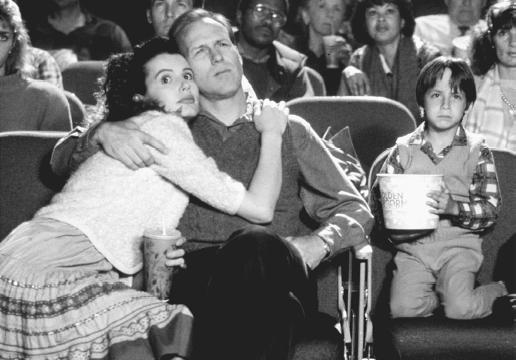
"I'm beginning to think that maybe it's not just how much you love someone.
Maybe what matters is who you are when you're with them."
- THE ACCIDENTAL TOURIST (1988)
dir: Lawrence Kasdan
Maybe what matters is who you are when you're with them."
- THE ACCIDENTAL TOURIST (1988)
dir: Lawrence Kasdan
Feb 6, 2009
173 Days of Anticipation
Sometimes a film trailer causes a tremor in your body like an electrical current; the images and sounds acting like a small stone skipping across a still pond. That feeling can be an almost extra sensory perception of something really special being advertised to your id and when it arrives it proves to be so ... or ...it can prove to be a false hope. That optimistic shimmer in my soul has happened a few times and has happened again with the trailer for 500 Days of Summer. This new film starring Joseph Gordon-Levitt and Zooey Deschanel (two actors I like an awful lot) was shown at this year's Sundance Film Festival. Here is the trailer (please click on the HQ option):
The images of Gordon-Levitt and Deschanel both smiling, looking dour, the song that accompanies the images, the hints of a fantasy musical number, the shot of Gordon-Levitt strutting in pure happiness past an orgasmic water fountain, both of the protagonists running through an IKEA store like the Truffaut characters in Jules and Jim, the sweater vests and thin ties, the Godardian title font, the shot of the golden waning sunlight blazing behind a dirty train window and the sound of that oddly voiced news broadcaster-like narrator intoning his description of what these 500 days of Summer are like; especially his one sentence description, "This is not a love story, it's a story about Love." It doesn't feel like romantic comedy fake fluff. It looks happy and it looks pessimistic. I like that. And I'm hopeful.
The images of Gordon-Levitt and Deschanel both smiling, looking dour, the song that accompanies the images, the hints of a fantasy musical number, the shot of Gordon-Levitt strutting in pure happiness past an orgasmic water fountain, both of the protagonists running through an IKEA store like the Truffaut characters in Jules and Jim, the sweater vests and thin ties, the Godardian title font, the shot of the golden waning sunlight blazing behind a dirty train window and the sound of that oddly voiced news broadcaster-like narrator intoning his description of what these 500 days of Summer are like; especially his one sentence description, "This is not a love story, it's a story about Love." It doesn't feel like romantic comedy fake fluff. It looks happy and it looks pessimistic. I like that. And I'm hopeful.
Feb 5, 2009
The Great Collaboration

90 years ago today (Feb. 5, 1919)
Douglas Fairbanks, Mary Pickford, Charles Chaplin and D.W. Griffith
formed the United Artists Distribution Company.
Dec 30, 2008
Dec 25, 2008

Dec 17, 2008
Toxic Thunder
 The state of modern comedy can be best seen in the very bloated schizophrenic foul-fest called Tropic Thunder. Okay, let me list each adjective and define:
1. BLOATED - Why is every comedy today inflated with minute after minute of time spent with obnoxious hateful "funny" characters? I realize a lot of the dvd versions of these Ben Stiller and Judd Apatow films are filled with added SPECIAL scenes not seen in theaters, but even before that Frankenstein stitching of extra funny bones, these films are still too long for fanny endurance in a cinema seat. Epic comedies are dead, people, and even they, in their prime in the 1960s, were stretching the limit. There is a reason they died. Comedy is best served on a small plate and eaten while it's still hot. A big serving becomes cold fast and unappetizing.
2. SCHIZOPHRENIC - Tropic Thunder's director, the truly unappealing Ben Stiller, wants this to be a comedy, right? Why then is it filmed like an action movie? Why the gritty cinematography best suited for Rambo or Oliver Stone? Why the portentous sound track? Why the CGI and slow motion explosions that want us to revel in the BOOM and the BANG? The idea of this film is that we are watching a fake war film. Why continue the look and sound after we know it is a comedy?
3. FOULFEST - I am no prude, but is constant swearing and tirades on oral sex truly funny? Shock comedy, yes. It hits you in the face and you react with a nervous laugh. But comedy today slams you in the face over and over again with a full fist of "fucks" and then rabbit punches you with more verbal vulgarity and this is supposed to funny. I swear, I truly believe that I could hire a bunch of Junior High School students and tell them to write a script and provide top grade technical equipment and they could produce a Summer Comedy Hit. Kids find swearing and sex jokes and over the top phony violence funny. Aren't we supposed to grow up? In a discussion with a co-worker, I was told that if Charlie Chaplin or Buster Keaton or W.C. Fields were allowed to say "fuck" or flash their posterior or fart, well, they would have done so. Why do I find that hard to believe? Stiller should look at his own parents. Anne Meara and Jerry Stiller based their comedy on "character" and verbal wordplay.
Tropic Thunder is supposed to be the funny epic comedy of a group of actors who are making an action war film and then are, accidentally, thrown into a real dangerous jungle situation involving drug smugglers. Only one of the actors still thinks he is in a film and that idiot is played by Ben Stiller who always plays an idiot or unlikable jerk. Idiots and unlikable jerks have always been comedy fodder. We have seen them as the protagonists of many comedy films. But we eventually like them and they change during the plot of the story. Stiller never does; he's always a humiliated asshole to the end. I have a natural aversion to Stiller. He is hard to look at; he resembles a cross between a monkey and Tom Cruise. (more on Tom Cruise in a minute!) Stiller is, also, the screenwriter and director and his idea is to make fun of actors and Hollywood and the people who make these type of big action films. The problem is that Stiller and his fellow co-stars, Jack Black (oh, is he insufferable in his screaming and heroin withdrawal ramblings), Matthew McConaughey and Tom Cruise are part of the very thing they are trying to make fun of; they themselves continue to make the same cliche, soulless, unfunny and/or dramatic action crap they aspire in this film to deride. So ... it doesn't work. It stinks as much as the dung they force upon the public every year. It is completely unbelievable as satire. I can believe Robert Altman or Blake Edwards when they poke fun at Hollywood, because I see them as people who dislike or have been burned by that environment ... not Ben Stiller running around with his Hollywood Gym muscled arms.
The only saving grace of this film is Robert Downey Jr. as an actor who so involves himself in his parts that he literally "becomes" what he is playing. In this case, he is playing a black man in the fake film in the film. He is so believable in this role that I actually forgot who he was Robert Downey Jr. He actual character is a blond haired Australian actor who he, also, plays flawlessly. Another actor who tries to be someone we don't associate with his usual roles is Tom Cruise. Cruise plays a vulgar fat Hollywood executive. He is covered in latex, a bald cap, wears tinted glasses and has body hair erupting from his unbuttoned shirt. The difference with Cruise is that we know right away that IT IS CRUISE. He can't act. He can't do a character. The smile, the smirk, the laugh is still there; no matter the make-up or the excessive vulgar language it is still empty old Tom Cruise trying to be funny. The fact that Stiller is now "buddies" with Cruise (a person he used to make fun of on his short lived TV show) and is planning a film, according to E! Online, starring this very Len Grossman character, is proof that Stiller hasn't a clue to what is funny. Can you imagine 90 minutes of ... oh, wait ... I mean, TWO HOURS or MORE of Cruise's bombastic foul Hollywood executive dancing to rap music and saying shit and fuck and dick over and over again? Wait, did I write the word "dick"? I did!! Are you laughing?
Dec 15, 2008
Oscar Winning Best Actors of the '60s: 1962

Winner: GREGORY PECK - To Kill a Mockingbird
other nominees:
____________
Burt Lancaster - Birdman of Alcatraz
Jack Lemmon - Days of Wine and Roses
Marcello Mastroianni - Divorce - Italian Style
Peter O'Toole - Lawrence of Arabia
I recall first seeing To Kill a Mockingbird as a Junior High School student. After being assigned and reading the novel for English class, we were treated to a showing of the film (shown in two installments) in the school auditorium. Viewing classic films based on classic novels was a staple at my school and we saw wonderful adaptations many times in those three years. The only handicap in watching the films was my sensitivity to the emotion the films conveyed. Most of these films involved scenes of death, failure, hopelessness and their musical scores were so lush and emotional. I was prone to tear up at times when the weight of the emotion affected me and this would cause embarrassment on my part and teasing on the part of my fellow classmates. In the case of the adaptation of Harper Lee's Pulitzer Prize winning book, I know I was wet-eyed a few times and I wanted to see if watching it again would turn the tap on once more. It did not. But, I did feel the slight melancholy I feel when I watch a film narrated by an adult who is telling the story of an incident in their childhood; for some reason it always affects me. And I did feel the warmth and security that glowed from the screen in the presence of Gregory Peck as Atticus Finch, the father of two children and a respected and wise lawyer in a Southern town.
Peck's presence dominates the film and it is probably his best known role. It, could be, to some, the only movie they think of when they think of the actor. His career was extensive; from his twenties to his old age. Atticus Finch defines Peck like Norman Bates defines Anthony Perkins, Oscar Madison defines Walter Matthau and Rick Blaine defines Bogart. He epitomizes the solid family man, the strong father, the sage who can answer all questions and whose whispers of assurance and love are warmer and more secure than a winter blanket on a cold night. There is one scene in particular when the children spot a rabid mad dog in the street in front of their home and they scream in alarm. The housekeeper spies the incoming trouble and her first thought and ours is to inform Atticus Finch. She does just that and we feel assured that he will solve this problem at once. He does, but he does so with humility and then pure laser-like intent. He is an admirable man on all fronts.
The film recounts the memories of his young daughter Scout and, in particular, the trial of a wrongly accused black man whom Atticus must defend against a charge of attacking a white woman. We know from the glaring hints of over acting from the girl's father that he is responsible for her beating and forcing her to pass blame on the accused. There is no question that Atticus is defending an innocent man in our minds. But, even so, due to Peck's portrayal we know, in our hearts, Atticus would never defend someone he suspected of being guilty unlike the thoughts we have of lawyers in today's world. Atticus is without blemish. He is as glaringly white and clean in his heart as is the suit he constantly wears even to the breakfast table. He is a unbiased man and, as is evident in movies of the 1960s, he is the great white father to the African American community; the protector and savior. This can be seen as a bit prejudicial in an ironic way, but Atticus never seems to be lording over or overbearingly pedantic with the community he protects. His sense of justice is universal to all and will even put himself in danger to defend his beliefs and protection of his charges. This is most evident in a scene where he stands guard outside the jailhouse door where the accused is being held. He sits in a chair on the jailhouse porch reading a book, a symbol of his intelligence and thought, with a rifle leaning against the door. Atticus will protect with his words and composed thoughts of decency than with the force of a gun. This is observed by his children and is a magnificent symbol of humanity for them and for the audience. We would all want a father like Atticus Finch.
Reading some material on the Oscar year of 1962, I learned that Harper Lee thought Peck was so much the embodiment of her real life father, that she gave Peck her father's pocket watch as a gift. He used the watch as a prop as he spoke in the courtroom scenes. He, later, kept it in his hand as he sat at the Academy Award ceremony and had it in his keep to his dying day. He said that the part of Finch was like "putting on an old suit of clothes - just comfortable". Maybe that is why he is so splendid in the role. The definition of the character was easy for him because it was more than just a "role". The role of an everyman, the role wherein an actor almost plays himself can be, I feel the most difficult role to play. In that case, Peck deserved the Academy Award that year.
Peck's presence dominates the film and it is probably his best known role. It, could be, to some, the only movie they think of when they think of the actor. His career was extensive; from his twenties to his old age. Atticus Finch defines Peck like Norman Bates defines Anthony Perkins, Oscar Madison defines Walter Matthau and Rick Blaine defines Bogart. He epitomizes the solid family man, the strong father, the sage who can answer all questions and whose whispers of assurance and love are warmer and more secure than a winter blanket on a cold night. There is one scene in particular when the children spot a rabid mad dog in the street in front of their home and they scream in alarm. The housekeeper spies the incoming trouble and her first thought and ours is to inform Atticus Finch. She does just that and we feel assured that he will solve this problem at once. He does, but he does so with humility and then pure laser-like intent. He is an admirable man on all fronts.
The film recounts the memories of his young daughter Scout and, in particular, the trial of a wrongly accused black man whom Atticus must defend against a charge of attacking a white woman. We know from the glaring hints of over acting from the girl's father that he is responsible for her beating and forcing her to pass blame on the accused. There is no question that Atticus is defending an innocent man in our minds. But, even so, due to Peck's portrayal we know, in our hearts, Atticus would never defend someone he suspected of being guilty unlike the thoughts we have of lawyers in today's world. Atticus is without blemish. He is as glaringly white and clean in his heart as is the suit he constantly wears even to the breakfast table. He is a unbiased man and, as is evident in movies of the 1960s, he is the great white father to the African American community; the protector and savior. This can be seen as a bit prejudicial in an ironic way, but Atticus never seems to be lording over or overbearingly pedantic with the community he protects. His sense of justice is universal to all and will even put himself in danger to defend his beliefs and protection of his charges. This is most evident in a scene where he stands guard outside the jailhouse door where the accused is being held. He sits in a chair on the jailhouse porch reading a book, a symbol of his intelligence and thought, with a rifle leaning against the door. Atticus will protect with his words and composed thoughts of decency than with the force of a gun. This is observed by his children and is a magnificent symbol of humanity for them and for the audience. We would all want a father like Atticus Finch.
Reading some material on the Oscar year of 1962, I learned that Harper Lee thought Peck was so much the embodiment of her real life father, that she gave Peck her father's pocket watch as a gift. He used the watch as a prop as he spoke in the courtroom scenes. He, later, kept it in his hand as he sat at the Academy Award ceremony and had it in his keep to his dying day. He said that the part of Finch was like "putting on an old suit of clothes - just comfortable". Maybe that is why he is so splendid in the role. The definition of the character was easy for him because it was more than just a "role". The role of an everyman, the role wherein an actor almost plays himself can be, I feel the most difficult role to play. In that case, Peck deserved the Academy Award that year.
Dec 6, 2008
Much of it Turns Out Not to Matter
 Lajos Kotai's film Evening, based on a Susan Minott novel, is really not a very good film. It seems very familiar in its telling of an elderly woman dying of a terminal disease, at home, being cared for by a night nurse and visited daily by her two daughters. The dying woman (Vanessa Redgrave) floats in and out of reality, fantasy and her memories of 50 years ago when she was the Maid of Honor at her best friend's wedding in Newport, Rhode Island. Claire Danes plays Ann Lord, the dying woman, in the flashback segments of the film. Ann is a young woman who dreams of becoming a professional singer and feels a bit out of place amongst the rich family and friends of her friend Lila (Mamie Gummer). She is connected to the family not only by her friendship with Lila, but with Lila's younger brother Buddy, whom Ann was close friends with in school. Buddy (Hugh Dancy) is high spirited, a dreamer, rebel to the family hopes and an alcoholic. He does not believe in his sister's love for her attended groom and believes she truly loves Harris (Patrick Wilson), the son of their housekeeper, who is, also, attending the wedding and is a physician. Glenn Close is the patrician mother of Lila and Buddy and Barry Bostwick cuts an imposing figure as the cliche stolid WASPish father. The film unfolds with the Chekovian equations of A loves B, but really loves C who loves B that adds up to a grandiose Lifetime-style cable movie
 The familiar qualities of Evening recall the soap opera-ish films of the late 1940s and, especially, the 1950s. One could see this starring Bette Davis or Joan Crawford in the '40s; Jane Wyman or a myriad of other actresses of the '50s period. Perhaps, Rock Hudson as Harris and James Dean as Buddy ... only the rather blatant hetero and homosexual currents would not surface as easily and would be swimming below the film's water line of plot. You see, Buddy loves Ann and he loves Harris and he drinks and has awkward alcohol infused outbursts at family dinner parties about love and society's false values. Buddy is the most interesting character in this film and his layers of emotion and hurt are greatly exposed by Hugh Dancy. Most of the other characters are bores and cardboard figures. I could not possibly see what Ann or Lila or Buddy saw in their love for Harris. He is as bland as a glass of warm 1% milk. Buddy's character reminded me of Lew Ayres' closeted younger boozy sibling of Katharine Hepburn in Holiday, though more nuanced and serious. The film would have, if made in the eras I referenced, been soaked in lingering soft focus shots and sweeping lavish strings and piano from a studio orchestra (we get, instead, an incongruous recording of Michael Buble singing a standard as Ann and Buddy dance lightheartedly). In the '50s this might have been made by Douglas Sirk and produced by Ross Hunter. Evening wants to be much more important than those soaps of the past cinema. It wants to "say" something. What it hammers into your head at the conclusion is that we fret and worry and wonder about the supposed mistakes we make in life, but that whatever road we take we will find happiness of a sort. Life is a culmination of mistakes that result in the life we have and that we should cherish. Relationships provide children and friends and memories that make us happy ... no matter what errors brought us to that point.
 Evening was a disappointment and it only provided a few glimmers of good acting. What the film did most of all for me was something that even a bad film can do; spark memory and allow you to relate. During my entire viewing of Evening, I thought back to incidents in my own life that these cinema ciphers enacted on the screen. It is so strange how film, if you allow it to envelop you, even if it isn't very good, can still affect you. Mediocre films can be easily ignored and that veil of separating yourself from your place in current time can be dispelled so easily by a film's failure to entrance a viewer. The magic was there in Evening and it worked. Having a parent die slowly and trying to understand her musings as you sit beside her, wondering what her life was really like as a younger person (we rarely think of our parents as once young); these scenes in the film struck me strongly.
 But, most of all, the thoughts of the younger Me and my relationships years ago with a family of my own acquaintance. My friendships with those people and the people I met through them; people I loved and those I disliked and who all changed me in some way and the way I thought about my true self. The hurts felt by Ann and Buddy; the misunderstandings and not speaking your mind and the guilt were all there on the screen and igniting the fuses of memory in my mind. Certain little incidents or scenes in the film made each of those memories explode ... thoughts I might express through the delirium of the twilight moments of my own end; secrets told to no one and known but to a few ... especially the love we feel and not speak of or act upon with the people we encounter in life or with our relations and parents ... and the moments of having our talents displayed to others who applaud us and see bright futures on the horizon that only turn to haze and clouds. Maybe, as the film tries to tell us, those mistakes don't really matter. Those incidents were wonderful, painful and educational, but whatever they meant at the time, what we thought to be so important, dismissive or earth shaking ... we still survive. Maybe what we did do or didn't was meant to happen and brought us to where we are today. We can still look back and regret and cherish and wonder what if ...? Maybe we can learn and hold dear what we did gain or what steps led us to where we now stand or those whom we have met and cared for even if we hadn't taken those other roads. I don't know if that is all true. But, I do know Evening provided the magic of taking me back to my past and making me think ... and that is one of the reasons why I love movies.
Nov 30, 2008
Oscar Winning Best Actors of the '60s: 1961
 Winner: MAXIMILIAN SCHELL - Judgment at Nuremberg
 other nominees:
__________
Charles Boyer - Fanny
Paul Newman - The Hustler
Spencer Tracy - Judgment at Nuremberg
Stuart Whitman - The Mark
Stanley Kramer's Judgment at Nuremberg is one of those big important issue pictures that started to become prevalent in the late 1950s and into the 1960s. It has an all-star cast headed by an aged Spencer Tracy as a judge presiding over the international trial of four German judges that handed down indictments of victims of the Fourth Reich. From reading, I have understood that this was originally a television drama that Kramer transformed into this mammoth 3 hour plus movie. Surprisingly, it has an overture and exit music, but no intermission. It is a static affair filled with histrionics, crying, blustering speechifying and crying for attention supporting roles by Montgomery Clift and Judy Garland. This film, supposedly, began the practice of Academy voters nominating "usual" head-liners in supporting categories. This enraged Hollywood gossip columnists, like Hedda Hopper, who thought it was an insult to allow a "star" to be thought of as a supporting player. Today, of course, it is common place and usually means a sure-fire win in that secondary category for the "star".
The star who, ironically, won the statuette for Best Actor this year was an actor who was not so known by American audiences at the time. Austrian born actor Maximilian Schell plays Hans Rolfe the German lawyer representing four judges who over saw the indictments of victims of the Fourth Reich. Schell had performed this role once before in the 1959 Playhouse 90 television production and was selected by Kramer to reprise his role several years later. Schell does an admirable job and you do pay a lot of attention to him when he is on screen. He poses an impressive figure; bold personality, strident voice and good looking dark features. His role is an odd one to honor in this category only because he plays a man who could be seen as a sort of villain. He is a man who strongly believes in the innocence of the men who allowed many to be sterilized, executed and sent to concentration camps for acts such as fraternizing with Jews and not being able to pass intelligent tests by the German officials. He believes in the duty of men to support the law of a land ... even if that law is unsound. However, Schell's Rolfe is a complex character; an honorable man who does not want his country to be thought of as entirely evil and corrupt; that there is still good there and these men were forced to do their duty whether sound or unsound. The opposing view, voiced by the usual blustering acting of Richard Widmark as the American military Captain in charge of the prosecution, is that evil acts should not be allowed whether they are law or not; evil should be stood up to and challenged. Schell poses a very good defense but ultimately loses, as we know from history and from the confession of guilt by one of his clients, that he admires greatly, played by Burt Lancaster (the winner of the previous year's Best Actor Oscar). He plays a learned renown German judge and professor of law who we find out hated the Fuhrer and all he stood for, yet upheld the edicts this monster and his Nazi officials had enacted into the law of the land.
Why did Schell win the prize? Good question. I found him adequate; he even has a spotlighted full-blown yelling to the rafters speech in the courtroom toward the conclusion ... pure Oscar bait. The film, though, dealt mostly with Spencer Tracy's role as presiding judge and his relationship with a German widow played by Marlene Dietrich. We spend almost the entire film with Tracy and his observations of German post-War life. Tracy was, indeed, nominated for Best Actor, but lost to Schell. And, most of all, I was impressed by Lancaster as the accused German judge. He is a fantastically fascinating character. He is stoic and appears evil and mysterious. As the film progresses you see his true nature and his moral dilemma. And the two powerhouse actors, Lancaster and Tracy, hold court in the final scene. Schell seems more of a supporting player to me and, perhaps, 1961 was a year that, through events or preoccupation with other matters of historical value, it was time for the Academy voters to hand the gold to a foreign actor.
Nov 25, 2008
Woody Movie Quotes #5: HANNAH AND HER SISTERS (1986)

Mickey: "Millions of books written on every conceivable subject by all these great minds and in the end, none of them knows anything more about the big questions of life than I do ... I read Socrates. This guy knocked off little Greek boys. What the Hell's he got to teach me? And Nietzsche, with his theory of eternal recurrence. He said that the life we lived we're gonna live over again the exact same way for eternity. Great. That means I'll have to sit through the Ice Capades again. It's not worth it. And Freud, another great pessimist. I was in analysis for years and nothing happened. My poor analyst got so frustrated, the guy finally put in a salad bar. Maybe the poets are right. Maybe love is the only answer."
Nov 24, 2008
Oscar Winning Best Actors of the '60s: 1960

Winner: BURT LANCASTER - Elmer Gantry
other nominees:
----------------
Trevor Howard - Sons and Lovers
Jack Lemmon - The Apartment
Laurence Olivier - The Entertainer
Spencer Tracy - Inherit the Wind
I've decided to watch, in succession, the Academy Award winning Lead Actors in the decade of the 1960s. Luckily, each of the 10 films I must view are available on dvd and I own them or can access them through the wonders of NetFlix. Starting with Elmer Gantry directed by Richard Brooks and based on the novel by the brilliant Sinclair Lewis, it is evident that the members of the Academy of Motion Picture Arts and Sciences have always loved those big brassy performances that declare an actor is on the screen in all his glory. Burt Lancaster portrays Elmer Gantry a traveling salesman who, though thrown out of the seminary as a younger man, ironically finds himself in the role of an Evangelist Tent Preacher. Gantry's morals are in question from the outset as we witness his duplicity, his drinking, his lying and his obvious lascivious manner toward the fairer sex. He becomes attracted to a famous evangelist Sister Sharon Falconer, played by Jean Simmons, whom he becomes entangled with in business and eventual romance. Gantry's cynicism and hucksterism is matched by Sister Sharon true beliefs and aim to serve God and help the masses. Her blind faith is in direct contrast to Gantry's earthy snake oil salesman approach. Lancaster is perfect in the role and he is at his most charming and toothy grinned best. His Gantry is all show; over the top thespian acting, bible thumping and going to the extent of using a monkey in his preaching to waylay the criticism of Darwin believing reporters. I can't think of another role of Mr. Lancaster's wherein he nears the perfection of what people think of when they hear his name or when I would see impersonators ape him on television. It is in the style of the few swashbucklers he was in early in his career. I like this performance, but find it hard to believe the public would find truth in this man's preaching. It is so phony, so oily, so grandstanding ... yet people looking for answers and faith and verbal balms to their earthly problems wold believe in most anything, especially anything that they believe God is telling them through a man in a seersucker suit and a silver tongue spitting out authority and fear; reduced to quivering souls ready to open their wallets for salvation.
I, personally, relish Mr. Lancaster's other style of acting. His quiet eccentric character studies in Sweet Smell of Success, From Here to Eternity, Atlantic City and Local Hero. He was a great actor and one I appreciated more so in his later years. As to the film by Mr. Brooks, I found it mediocre and found it very hard to forget the novel it is based on that I had read years ago. Sinclair Lewis' scathing portrayal of Gantry is hard to forget. Mr. Brooks, who won an Academy Award for his screenplay, portrays Gantry in this light, but he softens him and wants the audience to sympathize and actually turns him into a hero, of sorts by the conclusion. I try always to separate a film from its source material. Even if I could put the novel's text aside, I still would find this turnaround of this character a bit uncomfortable and the issues of believing and God as a business are different in the film and harder to stomach. This may be a cost of the time in which the film was released; certain parts of the novel may have been hard to pass by the censors. If this was the case, and not just poor story telling on Mr. Brooks' part, then more is the pity.
I, personally, relish Mr. Lancaster's other style of acting. His quiet eccentric character studies in Sweet Smell of Success, From Here to Eternity, Atlantic City and Local Hero. He was a great actor and one I appreciated more so in his later years. As to the film by Mr. Brooks, I found it mediocre and found it very hard to forget the novel it is based on that I had read years ago. Sinclair Lewis' scathing portrayal of Gantry is hard to forget. Mr. Brooks, who won an Academy Award for his screenplay, portrays Gantry in this light, but he softens him and wants the audience to sympathize and actually turns him into a hero, of sorts by the conclusion. I try always to separate a film from its source material. Even if I could put the novel's text aside, I still would find this turnaround of this character a bit uncomfortable and the issues of believing and God as a business are different in the film and harder to stomach. This may be a cost of the time in which the film was released; certain parts of the novel may have been hard to pass by the censors. If this was the case, and not just poor story telling on Mr. Brooks' part, then more is the pity.
Subscribe to:
Posts (Atom)
